
Breaking Down the Real 1978 Quarter Value
The objective 1978 quarter value is determined by a combination of three factors: the mint mark, the physical preservation of the surface, and the presence of expert-verified manufacturing defects.
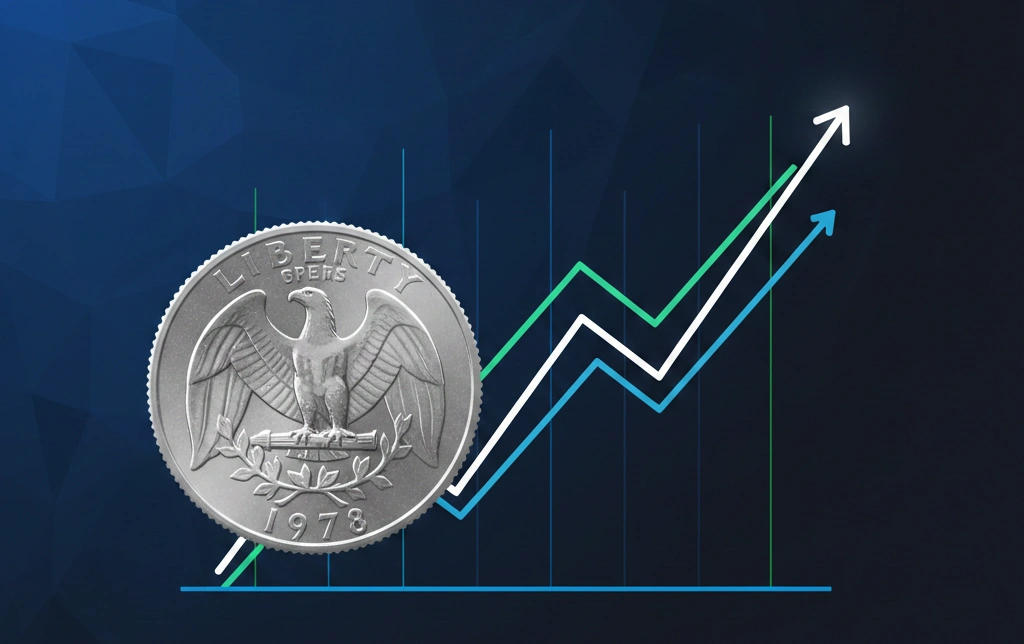
This issue, containing no precious metals, remains of interest to the market only upon reaching the highest grades on the Sheldon scale.
The 1978 emission was carried out under the standard program for copper-nickel clad coinage.
Mint Mark | Location | Mintage | Strike Type |
No Mark (P) | Philadelphia | 521,452,000 | Business Strike |
D | Denver | 287,373,152 | Business Strike |
S | San Francisco | 3,127,781 | Proof Strike |
The total mass of metal involved in the production of this series exceeded 4,600 tons.
Physical and Chemical Product Parameters
Adherence to these parameters is critical when identifying counterfeits or off-metal planchet errors.
Alloy: Outer layers consisting of a copper-nickel mixture (75/25) cladding a pure copper core.
Weight Tolerances: 5.67 g (allowable deviation ±0.194 g).
Geometry: Diameter of 24.26 mm, thickness of 1.75 mm.
Visual Markers: Absence of a mint mark on Philadelphia coins, located to the right of the bow in Washington's hair.
Pricing Based on Certification Grade
Market value increases exponentially when transitioning from MS65 to MS67+ grades.
Condition | Philadelphia (P) | Denver (D) | Annual Price Trend |
MS63 | $1.25 | $1.15 | -0.3% |
MS65 | $9.50 | $7.00 | +1.2% |
MS66 | $38.00 | $28.00 | +2.4% |
MS67 | $320.00 | $210.00 | +5.1% |
MS67+ | $1,250.00 | $900.00 | +7.8% |
A valuation exceeding 1,000 USD is possible only for specimens retaining 100% mint luster and lacking visible damage under 10x magnification.
Registry of Confirmed Auction Records
Sales statistics record the peak amounts paid for coins of this specific year.
1978-D Record: A specimen graded MS68 sold at Heritage Auctions in 2023 for 1,440 USD.
1978-P Record: A coin in MS67+ condition realized at 1,140 USD in 2019.
1978-S Record: A PR70 DCAM specimen sold for 420 USD in 2021.
Analysis indicates a 15% decrease in Proof coin prices over the last 5 years due to market saturation with graded samples.
Error Detection Valuation
Coins with deviations from the standard are appraised separately from regular business strikes and can be determined with the coin checker app.
Off-Center Strike
The value depends on the percentage of offset and the visibility of the date.
20% Offset: 45 – 75 USD.
50% Offset with full date: 200 – 350 USD.
Wrong Planchet Errors
The most valuable 1978 quarters are those struck on blanks intended for 5-cent (nickel) or 1-cent coins.
Weight 2.5 g (Copper planchet): Price from 600 to 950 USD.
Weight 5.0 g (Nickel planchet): Price from 750 to 1,100 USD.
Edging Errors (Missing Reeding)
The absence of reeding on the edge, while maintaining standard weight, increases the price to 120–180 USD.

Investment Attractiveness Dynamics
The investment potential of the 1978 quarter is limited to a narrow segment of high-quality coins.
Payback calculation for an MS67 graded coin:
Acquisition Cost (2024): $320.00.
Projected Value (2029): $410.00.
Total Return: 28% over 5 years (average annual growth of 5.6%).
Growth stability is ensured by the physical wear of the dies in 1978, which frequently led to "mushy" details on coins even in original bank rolls.
Self-Verification Methodology
Determining a coin's suitability for professional grading involves several stages.
Weight Verification: Utilizing electronic scales with 0.01 g precision to exclude worn specimens.
Surface Coin Value App Analysis: Searching for micro-scratches caused by contact in mint bags (Bag Marks).
Detail Assessment: Checking the sharpness of Washington’s hair and the feathers on the eagle’s wings.
The presence of any wear on the highest points of the relief automatically reduces the grade to AU (About Uncirculated), making the market value equal to face value.
Market Risks and Constraints
The 1978 coin market is characterized by high dependency on professional grading service conclusions.
"Population Explosion" Risk: The opening of new bank boxes may lead to hundreds of MS66 coins entering the market, reducing the price of this segment by 30–40%.
Liquidity: Coins valued below 10 USD have extremely low liquidity due to high shipping costs.
Counterfeit Defects: There are increasing cases of mechanical edge grinding to simulate manufacturing defects.
Unlike the 1976 commemorative quarters, the 1978 issue possessed no initial collector status.
Parameter | 1978 (P) | 1976 (P) Clad |
Mintage | 521 Million | 809 Million |
MS67 Scarcity | High | Medium |
Average MS67 Price | $320.00 | $150.00 |
Technological defects in 1978 make finding a flawless coin a more difficult task than finding a 1776–1976 commemorative quarter.
Market Outlook Through 2030
A steady demand for MS67+ graded coins is projected to persist.
Expected price levels by 2030:
MS67 (P): $450.00 – $520.00.
MS67 (D): $280.00 – $340.00.
Unique Errors (Wrong Planchet): $1,500.00+.
Growth in value will be supported by collectors striving to complete high-end Washington Quarter Registry Sets in maximum preservation.