
Comparing the 1944 Penny Value to Other Wartime Cents: 1942, 1943, and 1945
The 1944 penny value is often discussed in collector circles because it stands at the center of a major change in U.S. wartime metal policy. The United States Mint adjusted compositions several times between 1942 and 1945 to meet military needs for copper, zinc, and steel.
These production changes resulted in visible differences in surface color, strike quality, and overall durability. Understanding the 1944 cent in its wartime context helps clarify why certain pieces are common, why others are rare, and which characteristics determine actual market value today.
Collectors often compare the 1944 penny to its immediate neighbors:
1942, which still used pre-war alloy but shows transitional strike behavior
1943, struck on zinc-coated steel
1945, a return to stabilized post-war planchet supply
Right now we would like to examine the 1944 cent first, then compare it against other wartime years to show how composition and minting conditions influence value across the period.
The 1944 Penny: Shell Case Brass and Adjusted Minting
In 1944, the Mint used recycled cartridge cases as feedstock for cent planchets. These cartridges came from training grounds and battlefield recovery. Melted down and refined, they produced a brass alloy averaging about 95% copper and 5% zinc. This is often called “shell case brass.”
The alloy change is important because it affects how the coin ages. Surface tone, oxidation behavior, and luster response differ from earlier bronze cents. 1944 pennies often show warmer tone variation and distinct oxidation patterns, especially when stored in mixed humidity.
Appearance Characteristics of 1944 Brass Cents
Slightly warmer color than 1930s bronze cents
Luster that can appear softer if the planchet surface was not polished uniformly
Oxidation developing into red-brown (RB) or full brown (BN) tones over time
Mint Production
Three mints produced the 1944 cent:
Philadelphia (no mint mark) – largest output
Denver (D)
San Francisco (S)
All three mint releases are common in circulation grades because cent distribution remained high during wartime domestic commerce.
Condition and Eye Appeal: How Value Emerges in Common Dates
Since most 1944 pennies are common, condition is the main factor determining value. Circulated coins have flat fields, weakened wheat stalks, and broken luster. These do not carry notable premiums.
Collectors focus on:
Surface texture stability
Original luster rotation (cartwheel effect)
Color classification (RD, RB, BN)
The color designation alone can change the price significantly.
Color and Grade Influence on Market Value (Typical)
Grade / Condition | Typical Price (USD) | Key Visual Indicators |
Circulated (G–VF) | $0.05–$0.30 | Dark tone, flattened wheat tips |
XF–AU | $0.40–$4 | Partial luster remains, minor handling |
MS60–MS63 | $5–$15 | Uncirculated but scattered marks |
MS64 | $18–$35 | Cleaner fields, moderate cartwheel |
MS65 RB/BN | $40–$90 | Balanced tone, stable surface |
MS65 RD | $120–$250+ | Full red tone, no major breaks |
MS66 RD+ | $300–$800+ | Scarce, strong visual appeal |
The highest demand appears at MS65 RD and above. These coins are not common in raw finds and usually trace back to long-stored original rolls or album-positioned sets.
The 1944 Steel Penny: A Rare Product of Transition
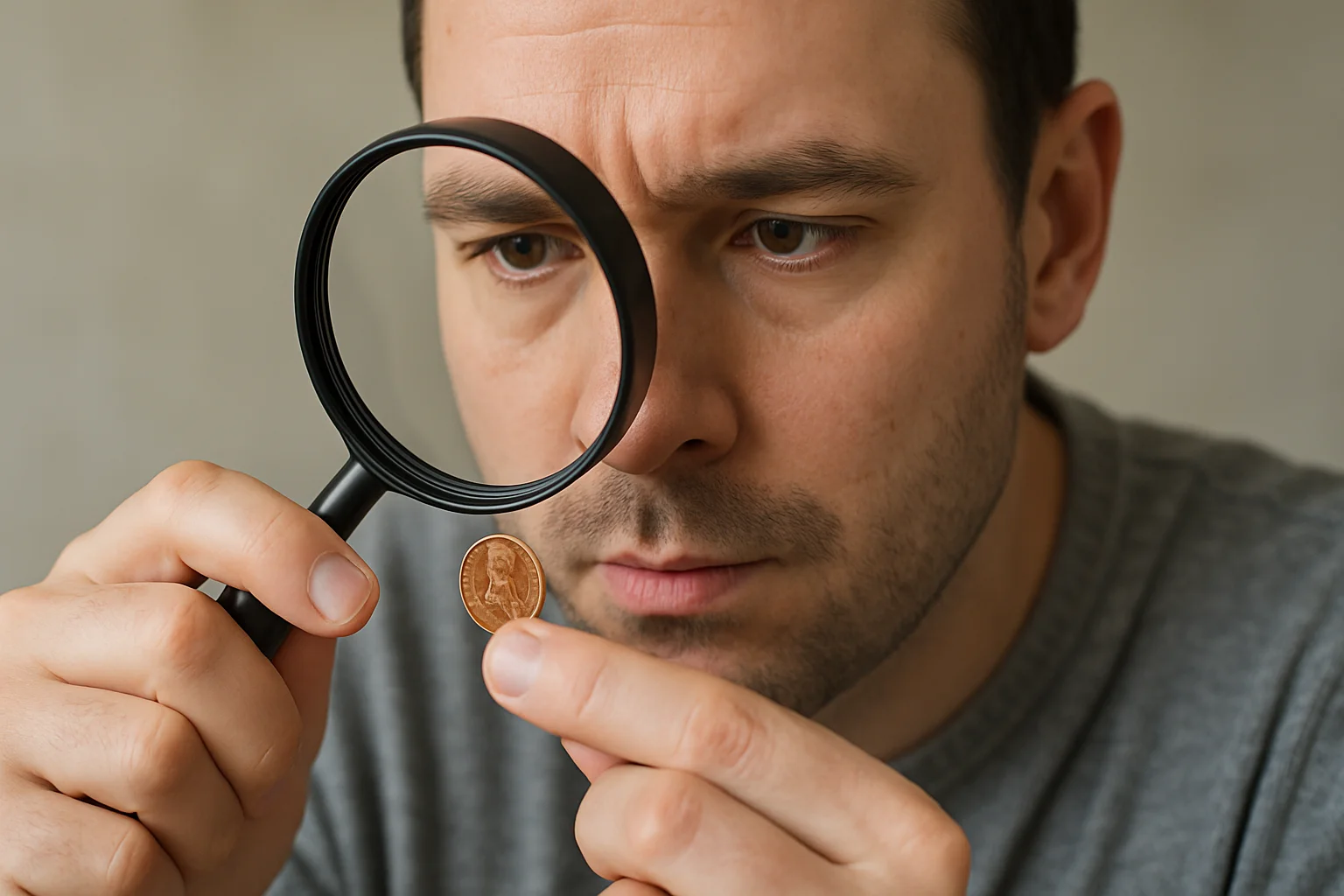
Most 1944 cents are brass. However, a small number of steel planchets remained in minting equipment from 1943 production. These planchets were accidentally struck with 1944 dies. This created the rare 1944 steel penny.
These coins must be identified carefully. Market value depends on authenticated composition, not visual appearance. Surface recoloring or environmental changes can mimic tone differences, but metal identification removes uncertainty.
Verified Auction Results (Confirmed)
Coin | Grade | Price (USD) | Auction / Date |
1944 (no mint mark) Steel | PCGS MS64 | $180,000 | Heritage, June 20, 2021 |
1944-S Steel | PCGS MS66 | $373,750 | Heritage, July 1, 2008 |
1944-D Steel | NGC MS62 | $66,125 | Stack’s Bowers, Aug 23, 2018 |
These results show that value arises from metal type and authenticity more than grade numbers. Even lower-grade steel 1944 cents are rare.
Quick Metal Verification Checklist
Magnet Test:
Attracted → steel.
Not attracted → check weight.
Weight:
Steel ~2.70 g
Brass ~3.11 g
If non-magnetic and ~3.11 g:
Submit to PCGS or NGC for authentication.
This prevents misidentifying plated fakes or corroded surfaces.
Comparison with Other Wartime Cents
1942 Cents: Pre-War Alloy with Transition Signs
The 1942 penny continued the pre-war bronze alloy of 95% copper with small percentages of tin and zinc. The metal behaves differently from the recycled brass seen in later wartime years. During 1942, the Mint prepared for changes in composition due to industrial copper demand.
This is visible in small shifts in production quality. Some dies from late 1942 show softer strike pressure and reduced field polish because tooling was pushed longer without replacement. Earlier strikes display sharper wheat kernel edges and smoother fields.
Value Characteristics
Circulated 1942 cents remain common and inexpensive.
Premiums begin at MS65 Red and above, where the original luster is strong and surfaces retain uniform tone.
Strike sharpness depends on the die state. Coins struck early in a die’s life show clearer detail than those from worn dies.
Collectors evaluating 1942 pieces compare design details like cheek smoothness, field texture, and the wheat tip definition to identify stronger examples.
1943 Cents: Zinc-Coated Steel
The 1943 penny reflects full wartime copper diversion. The Mint replaced bronze with steel planchets coated in zinc. Fresh coins appear light silver-gray, but the coating wears quickly. Once zinc thins, steel darkens and can corrode from environmental exposure.
These coins are magnetic, which makes basic identification simple. They also sound different when tapped lightly on a hard surface, producing a sharper ring than copper alloys.
Surface Characteristics
Bright, reflective surfaces when freshly struck.
Darkening or spotting develops if storage conditions were poor.
Corrosion occurs where zinc has worn away to expose steel.
Market Notes
Circulated 1943 cents typically sell for $0.10–$2.
High-grade examples with full, unbroken luster and clean fields trade higher, especially in MS65 and MS66.
Rust or mottled surfaces lower value permanently because corrosion cannot be reversed without visible surface loss.
1945 Cents: Continued Shell-Case Brass Use
In 1945, the U.S. Mint continued the use of shell-case brass, repurposed from spent cartridge cases. Wartime demand eased slightly in the final phase of the conflict, so minting conditions improved.
Coin surfaces often show more consistent tone and strike depth compared to some 1944 outputs. However, differences still appear across mints. Denver coins may show light contact clusters from bulk handling, while San Francisco examples may show moderate softness at central high points.
Value Differences from 1944
Higher likelihood of stable Red surfaces in uncirculated grades compared to 1944.
Strike strength varies by mint, so evaluating cheek and wheat tips helps distinguish premium pieces.
Condition and tone stability remain the primary factors in price, not the date alone.
Collectors compare 1944 and 1945 cents side-by-side to learn how brass aging differs by batch and storage environment.
Side-by-Side Summary Table
Year | Metal Composition | Common Value Range | Key Rarity Feature |
1942 | Bronze (copper–tin–zinc) | Mostly low unless MS Red+ | Strong early-die strike examples |
1943 | Zinc-coated steel | Common in worn grades; MS premiums exist | Requires careful luster and surface preservation |
1944 | Shell-case brass | Common except MS65+ Red | Stable color and clean cheek surfaces drive premium |
1944 Steel | Accidental leftover steel planchets | Extremely rare | Must be authenticated, not judged by color |
1945 | Shell-case brass | Similar to 1944 but slightly more uniform in tone | High-grade Red examples with clean fields |
This table highlights how metal and condition, not just the date, determine price.
Practical Evaluation Method
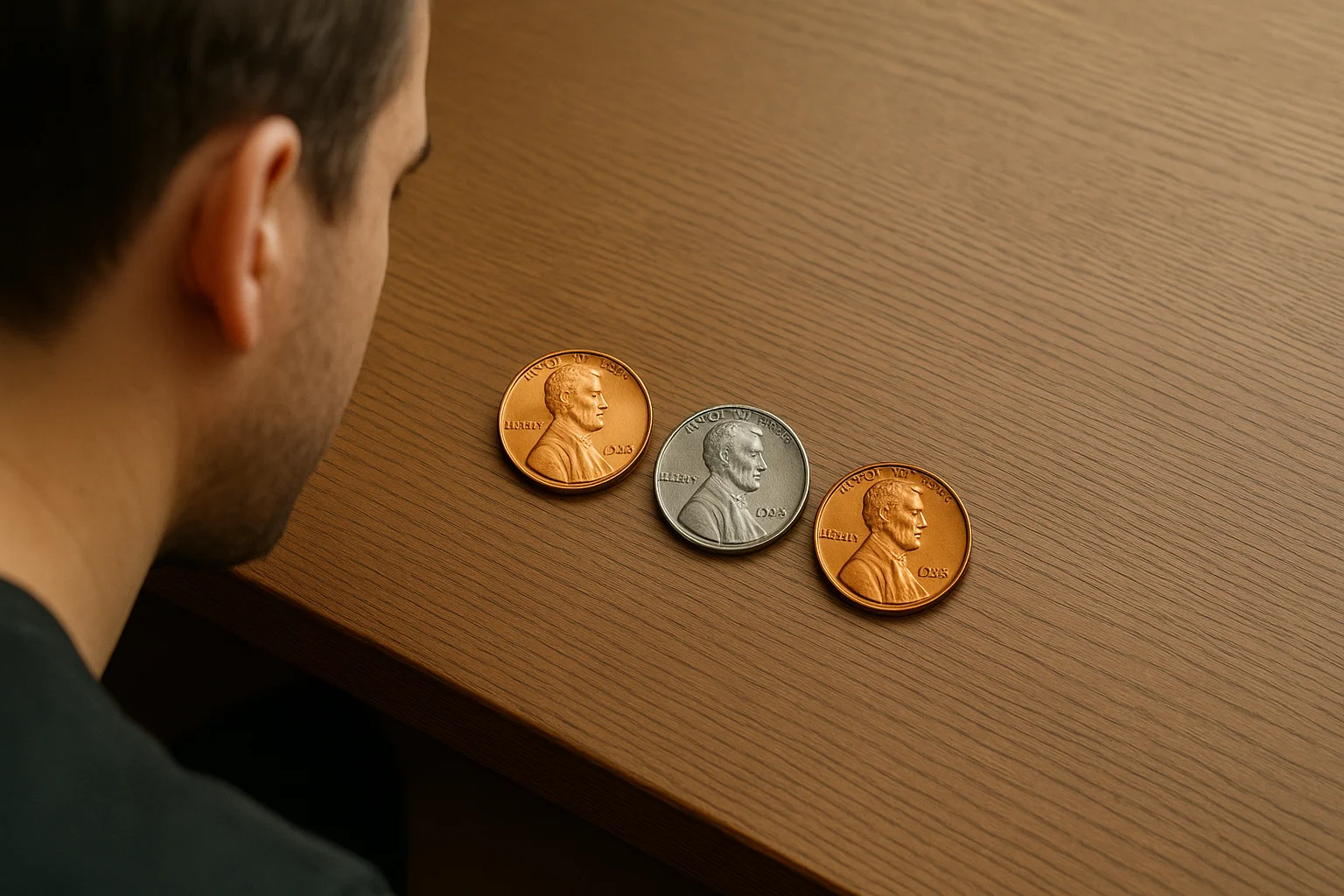
A structured inspection helps separate ordinary coins from valuable ones. Evaluate each wartime cent using the same steps to avoid overestimating grade.
Confirm metal composition
Magnet test and weight establish whether the coin is steel or brass.
Check strike consistency
Study high points such as Lincoln’s cheek and jaw, and wheat tips on the reverse.
Rotate under angled light
Observe cartwheel luster. Continuous luster indicates original surfaces.
Determine color category (Red / Red-Brown / Brown)
Color reflects storage history and influences pricing.
Compare against certified examples
Reference coins graded by major services prevent misjudging weak strike as wear.
This method separates condition evaluation from assumptions and helps prevent confusing cleaned or re-toned pieces with naturally preserved examples.
The 1944 Penny and Its Wartime Neighbors
The wartime years did not produce one uniform cent. Each year reflects a different stage of metal supply, die wear, and production pressure. The 1944 penny is common in circulated grades, but eye appeal and color separation matter in higher mint state. The steel 1944 cents are rare and must be confirmed by metal testing and certification.
Use a stable evaluation routine: check metal, review luster under angled light, inspect the cheek and fields, and compare with known certified examples. Small differences in surface quality change prices sharply.
To keep coins organized, photographed, and documented, collectors often store notes on each piece. Coin ID Scanner allows you to record weight, appearance, and metal reaction, and maintain a clear digital collection. This helps separate everyday examples from coins worth closer inspection.